Warsaw Public Transport Safety: A 2026 Guide to the Metro, Trams, and Night Buses
Last updated June 2026, Warsaw public transport safety remains one of the easiest parts of planning a trip to Poland's capital: the ZTM network of two metro lines, trams, and buses is clean, affordable, and monitored, and most incidents travelers report are wallet-related rather than violent. The real risks sit in predictable, avoidable places — a crowded carriage on the Old Town bus route, a ticket machine at Dworzec Centralny, or a taxi that isn't actually a taxi — and this guide walks through each one with practical fixes. For the bigger picture on how Warsaw compares to other European capitals, the overall Warsaw safety guide is the place to start before diving into transit specifics.
Warsaw Public Transport Safety: The Quick Answer
Warsaw's public transit is consistently regarded as one of the more secure systems among European capitals, and in daily use it earns that reputation: trams, buses, and Metro cars are modern, well-lit, and increasingly fitted with onboard CCTV, which discourages the petty theft that occasionally affects busier routes. The bigger practical risk isn't crime at all — it's an unvalidated ticket and a fine you didn't see coming. Where transit safety gets murkier is off the ZTM network entirely: unlicensed taxis touting for business outside the station or the airport carry far more risk of overcharging or a genuinely unsafe ride than any bus or Metro car does, so sticking to the metered, app-verified options covered further down is the single best upgrade you can make to a Warsaw itinerary.
The ZTM Network: Metro, Trams, and Buses
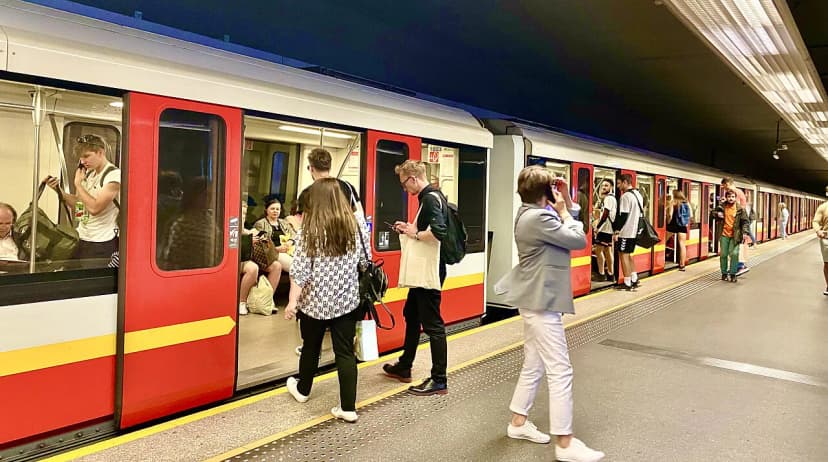
ZTM (Zarząd Transportu Miejskiego) runs the integrated network of Metro, trams, and buses that most visitors will use daily. The Metro's two lines, M1 and M2, are widely considered the safest mode in the city: platforms and cars are staffed, well-lit, and covered by heavy camera presence, and the underground environment removes the traffic and street-level friction that trams and buses deal with. Trams and daytime buses are safe and heavily used by commuters and tourists alike, though attentiveness to belongings matters more during rush hour crowding than it does late at night, when carriages simply empty out. For trips beyond the city core — including to Modlin airport or suburban stations — SKM and Koleje Mazowieckie commuter trains run on a separate regional ticketing system from ZTM, and mixing up the two is one of the most common ways travelers end up with an invalid ticket without realizing it.
| Mode of Transport | Editorial Safety Notes | Best For |
|---|---|---|
| Metro (M1 & M2) | Considered the safest mode in our editorial assessment — staffed, well-lit, heavy camera coverage | Cross-city trips, late-evening travel |
| Trams | Safe day and night; busier carriages call for normal bag awareness at peak hours | Old Town, city-center hops |
| Daytime buses | Safe and well-used; Bus 175 corridor sees denser tourist and pickpocket traffic | Airport-to-center, sightseeing routes |
| Night 'N' buses | Safe but quieter; stops and waiting areas warrant more attentiveness after midnight | Late-night returns when the Metro is closed |
| SKM / Koleje Mazowieckie | Safe regional trains; separate ticketing from ZTM is the main practical pitfall | Suburbs, Modlin airport connections |
Riding the Night Buses ('N' Lines) Safely
Once the Metro and most daytime lines stop running, Warsaw's network of night 'N' buses takes over, radiating out from a central hub at Dworzec Centralny (Warsaw Central Station). The system works on the same ZTM tickets as daytime transit, just on a reduced, less frequent schedule, so waits at stops are naturally longer and platforms quieter. That quiet is the main thing to plan around: stand in a well-lit, populated part of the stop rather than an empty stretch of pavement, and keep valuables zipped away while waiting rather than mid-transaction with a phone or wallet out. For a short late-night hop where the nearest N-line connection is inconvenient or the wait feels too long, a vetted ride-share is a reasonable substitute — see the dedicated guide to Warsaw at night for a fuller breakdown of after-dark decision-making.
Avoid the Ticket Validation Fine (Not a Scam, But It Feels Like One)
The single biggest safety-adjacent risk on Warsaw transit isn't crime — it's an unvalidated ticket. Paper tickets bought from a machine or kiosk must be stamped in the small validators mounted inside trams and buses (and at Metro station entrances) the moment you board; mobile tickets bought through apps like Jakdojade, SkyCash, or moBilet are validated automatically at purchase and don't need a separate stamping step, which is exactly why they've become the lower-friction, lower-risk option for visitors. Ticket inspectors work the network regularly and in plain clothes, asking to see your ticket and ID; if it isn't validated, the on-the-spot fine applies regardless of whether you intended to pay or genuinely didn't understand the system. The other classic trap is ticket confusion: a ZTM city ticket does not cover Koleje Mazowieckie regional trains, and vice versa, so travelers connecting toward the airport or suburbs sometimes get fined for carrying the wrong ticket type rather than no ticket at all.
Mobile tickets through Jakdojade, SkyCash, or moBilet automatically validate on purchase, eliminating fine risk and sidestepping distraction theft concentrated at ticket machines in crowded hubs like Dworzec Centralny—a dual advantage that addresses the confusion catching airport-bound travelers.
Pickpockets and Common Transit Scams
Petty theft on Warsaw transit concentrates in a few predictable spots rather than spreading evenly across the network. Dworzec Centralny (Warsaw Central Station) is the city's clearest pickpocket and general-grit concentration point, thanks to the volume of tourists, luggage, and distracted transfers passing through it daily, and the Bus 175 corridor linking the airport to the Old Town sees similar density. A common tactic at ticket machines is the 'helpful stranger' approach, where someone offers unsolicited assistance buying a ticket and either overcharges, pockets change, or distracts long enough for a bag to be opened. Keeping bags zipped and to the front in these specific zones, and politely declining unsolicited machine help, closes off most of this risk; the rundown of Warsaw tourist scams and the Warsaw crime rate context both go deeper on how these patterns compare to the city's crime picture overall.
Rideshare and Taxi Safety
Licensed taxis and app-based ride-share (Uber, Bolt, FreeNow) are widely available and generally safe, but the risk profile shifts sharply outside the ZTM network: unlicensed drivers touting for fares directly outside the station or airport arrivals hall are the main source of overcharging complaints and the occasional genuinely unsafe ride. Booking through an app rather than flagging a car on the street means the plate number, driver name, and route are all recorded before you get in, so it's worth taking the extra thirty seconds to confirm the plate matches what's shown on screen before opening the door — a simple habit that eliminates almost all of the 'fake taxi' risk travelers ask about.
Solo and Female Traveler Tips on Transit
Solo travelers, and women traveling alone in particular, generally find Warsaw's transit network comfortable to use independently, day or night. On the Metro, the first carriage (closest to the driver) tends to stay more populated and visible later in the evening, and on buses, seats near the driver offer the same practical advantage of visibility and quick access to help if needed. These are small positioning choices rather than signs the network is unsafe — they simply stack the odds further in your favor on quieter late-night runs. The solo female travel safety guide for Warsaw covers the broader picture beyond transit, including neighborhood choice and evening habits.
Choosing Where You Stay Shapes Your Commute
Because so much of the transit safety picture comes down to which stops and routes you're using rather than the network itself, where you base yourself matters. Staying in one of the Safest Neighborhoods in Warsaw: A 2026 District-by-District Safety Guide generally means shorter, better-served connections to the center and less reliance on late-night transfers through busier hubs. It's equally worth reviewing the guide to areas to avoid in Warsaw before booking, since a handful of districts are better treated as pass-through stops on a tram rather than places to base an evening around.
Staying in safer neighborhoods reduces exposure to Dworzec Centralny and Bus 175 corridor—the two pickpocket-heavy hubs—by shortening commutes and limiting late-night transfers through crowded areas where distraction theft clusters most densely.
Practical Logistics: Apps, Tickets, and Accessibility
Jakdojade remains the standard route-planning app for Warsaw transit, pulling together Metro, tram, bus, and regional rail schedules in one place and reducing the guesswork that leads to wrong-ticket fines in the first place. ZTM's fare structure is built around time-limited tickets rather than single-journey fares in the way some cities use them — a 20-minute ticket covers short hops, while a 75-minute ticket covers most cross-town Metro-to-tram connections, and both should be checked against current ZTM postings before travel since fare details are periodically revised. Mobile ticketing through Jakdojade, SkyCash, or moBilet also smooths accessibility for travelers with strollers or limited mobility, since it removes the need to locate a working validator machine on unfamiliar platforms, though step-free access still varies by individual Metro and rail station.
Emergency Contacts and Final Verdict
Taken as a whole, Warsaw public transport safety is a strong argument for using the network rather than avoiding it: the Metro, trams, and buses are well-monitored, affordable, and reach nearly everywhere a visitor needs to go, with the main friction points being avoidable ticketing mistakes and a small number of pickpocket-heavy hubs rather than any broader threat. It's also worth noting, without overstating it, that regional context — including the security posture connected to the nearby war in Ukraine — has kept a heightened but not alarming security presence around Poland generally, which has not translated into any particular risk to tourists using city transit. In an emergency anywhere in Poland, including on board transit, dial 112, and report any theft or incident to the nearest station staff or police as soon as possible so it can be logged.
Airport Transfers: Chopin, Modlin, and Ticket Boundaries
Airport transit is one place where Warsaw’s safety and ticketing rules overlap. From Warsaw Chopin Airport, the safest public option is usually the signed train or Bus 175 corridor rather than accepting rides from drivers approaching arrivals; keep luggage close at Warszawa Lotnisko Chopina, Centrum, and Dworzec Centralny, where crowding makes distraction theft more plausible.
Modlin Airport needs more care because it sits outside the normal city-core pattern. Many travelers connect via Warszawa Centralna toward Modlin station and then use the airport shuttle, so confirm whether your itinerary uses ZTM, SKM, Koleje Mazowieckie, or a combined airport ticket before boarding. The safety issue is not the train itself, which is generally routine and commuter-oriented, but carrying the wrong ticket on the right-looking service. If you are tired after a late arrival, buy through an official machine, app, or staffed counter and ignore unsolicited help around the station concourse.
Frequently Asked Questions
Is it safe to use the Warsaw Metro at night?
Yes — the Metro is widely considered the safest mode on the network thanks to staffed, well-lit stations and heavy camera coverage, and it runs until the network's normal daily close before the night 'N' bus system takes over.
What happens if I forget to validate my ticket in Warsaw?
Ticket inspectors check regularly, and an unvalidated paper ticket is treated the same as having no ticket at all, resulting in an on-the-spot fine — mobile tickets bought through apps like Jakdojade avoid this entirely since they're validated automatically at purchase.
Are night buses safe if I'm traveling alone in Warsaw?
Generally yes, though the 'N' network runs less frequently than daytime service, so waits are longer; sticking to well-lit, populated stops near the Dworzec Centralny hub and choosing a vetted ride-share for very late or inconvenient connections covers most of the risk.
Where do pickpockets target on Warsaw transit?
Dworzec Centralny (Warsaw Central Station) and the Bus 175 corridor between the airport and Old Town see the most reported pickpocketing, largely due to tourist volume and luggage rather than any broader crime problem.
Do I need a different ticket for the airport train than for city buses?
Often yes — Koleje Mazowieckie and SKM regional trains run on separate ticketing from ZTM city buses, trams, and Metro, so it's worth confirming which ticket type covers your specific route before boarding to avoid a mismatched-ticket fine.